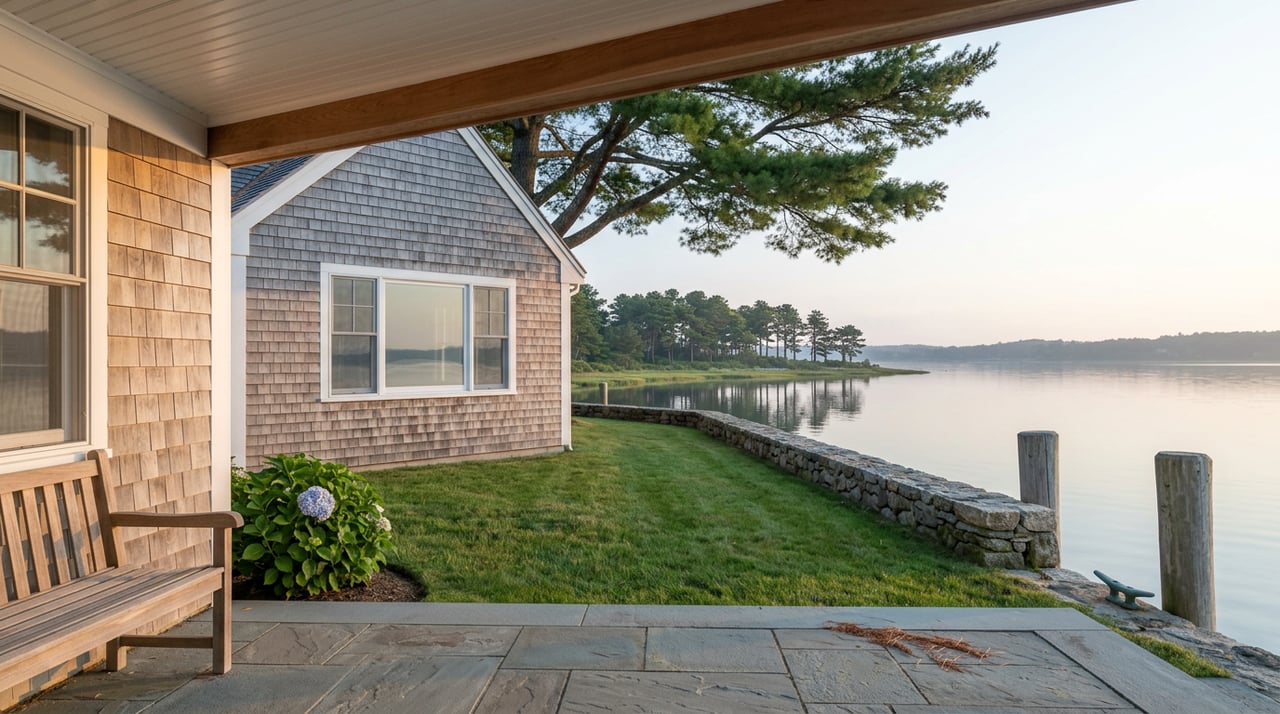
If you've been watching the market and saw that Barnstable's median sale price landed around $705,000 over the three months ending August 2026, a fair question follows: why does a Cotuit listing near you keep showing up over a million dollars? Or an Osterville estate closer to $1.3 million?
The answer isn't that the portal got it wrong. It's that "Barnstable" isn't one market pretending to be seven villages. It's seven markets that a single median price statistic mashes into one number, and the number that comes out the other side belongs to none of them individually.
One Town, Seven Very Different Streets
Barnstable is the largest town on Cape Cod by population and the only one built from seven distinct villages: Hyannis, Barnstable Village, West Barnstable, Marstons Mills, Centerville, Cotuit, and Osterville. That structure isn't incidental. It traces back to how the villages grew. Rail service reached West Barnstable and Barnstable Village by December 1853, and when the line's southern terminus opened in Hyannis the following July, that village's deep water port set it up as the commercial and shipping center it remains today. The south-side villages, Cotuit, Osterville, and Centerville, grew differently, pulled along by the late-19th-century seaside resort boom rather than commerce.
That history still shows up in the price data. Hyannis functions as the town's retail, medical, and transportation hub. Cotuit and Osterville function as harbor-oriented residential enclaves with a fraction of the housing turnover. When a single town-wide median blends a high-volume commercial village with two low-volume waterfront villages, the number that results describes an average that no actual buyer experiences.
What $705,000 Actually Buys, Depending on Which Side of Town You're On
Here's where the gap gets concrete. As of Redfin's data covering the three months ending August 2026, Barnstable's town-wide median sale price sat at $705,000, down 3.1 percent from the same period a year earlier, with a median price per square foot of $478, up 16.4 percent year over year, and homes taking an average of 28 days to sell, compared to 23 days the prior year.
Now put that next to the south side.
| Where | Recent 2026 price signal | Typical time to sell |
|---|---|---|
| Barnstable, town-wide | $705,000 median sale price, three months ending August 2026 | 28 days |
| Cotuit | Typical home value near $846,651 as of late February 2026, with recent sale prices clustering closer to $1.295 million | Around 100 days |
| Osterville | Typical home value near $1,140,293 as of late February 2026, with recent sale prices clustering closer to $1.345 million | Around 110 days |
Notice that even within Cotuit and Osterville, two different numbers disagree with each other. The typical home value measures the whole housing stock, most of which never changes hands in a given window. The median sale price measures only what actually traded. When those two figures pull apart by a substantial amount, it tells you something specific: in a given stretch of months, only the higher end of each village's inventory is moving. The modest cottages sitting behind the harbor-front estates simply aren't listed often enough to pull the median back down.
That's the first crack in the "one Barnstable" story. The second one is more surprising.
The Twist: The Priciest Villages Aren't the Best Protected
You'd assume the villages commanding the steepest premiums are the ones locked down by historic district rules that keep teardowns and mismatched new construction out. That assumption runs backward in Barnstable.
The town's own Historic Preservation Plan is direct about this. West Barnstable, Barnstable Village, and Hyannis have their business districts covered by formal local historic district designations, the kind with actual design review over exterior changes. Those are three of the town's more moderately priced villages. Meanwhile, the plan states plainly that the village centers of Cotuit, Marstons Mills, and Osterville, some of the highest-priced real estate in town, remain at risk of losing their historic character because no effective design guidelines exist there. Centerville picked up a District of Critical Planning Concern designation, which brings design review to new construction, but that's a comparatively recent addition, not a decades-old safeguard.
Cotuit does carry a National Register of Historic Places listing, dating to 1987, covering roughly 95 acres and more than 100 structures along Main Street and the harbor. That's a real designation, but a National Register listing mostly confers recognition and eligibility for certain tax incentives. It doesn't function like a local historic district, where a review board actually has to approve changes to a home's exterior before an owner can proceed.
The town's planning language on this point is unambiguous: Cotuit, Osterville, and Marstons Mills have faced "significant development pressures along their coastlines" since 1990, and that pressure has intensified precisely because no local design guideline exists to slow it down.
So if formal preservation rules aren't what's keeping Cotuit and Osterville expensive, what is?
The Real Scarcity Is Geographic, Not Regulatory
Cotuit's own village plan spells it out. The village is surrounded on three sides by Popponesset Bay, Cotuit Bay, and the Santuit River, with the School Street Bridge serving as the primary outside connection into Mashpee. That's not a zoning restriction. That's water on three sides of a peninsula, which caps the number of buildable lots regardless of what the town's building code allows.
Osterville's version of the same mechanism runs through private clubs rather than a bridge. The Osterville Village Association has maintained an active civic presence for fifty years, and the village's identity was shaped by resort development that began at Wianno in the 1880s and continued at Oyster Harbors in the 1920s. The Wianno Club and Oyster Harbors Club, along with working marine businesses like Crosby Yacht Yard and Oyster Harbors Marine, create a social and logistical infrastructure that only exists because of proximity to the water. None of that requires a preservation ordinance to sustain demand. It sustains itself.
That's the part a town-wide median can't show you. The premium in Cotuit and Osterville isn't a policy outcome. It's a supply constraint drawn by a coastline that predates any zoning map the town has ever written.
Why the Town's "28 Days" Doesn't Describe the South Side
Here's where the numbers stop being abstract for anyone actually shopping. Barnstable County as a whole recorded a median of 42 days on market in the first quarter of 2026, up 12 days from the prior year, with homes selling an average of 2.87 percent below asking. That's a market where buyers have gained a bit of room to negotiate.
Cotuit and Osterville aren't playing in that same window. Their days-on-market figures, closer to 100 and 110 respectively in early 2026 snapshots, run well past even that loosened county pace. A separate report covering the six months ending May 19, 2026 made the same point about the south side: sellers there should expect longer marketing timelines, but not because the market is soft. It's because the buyer pool is smaller and more selective, and those buyers are willing to wait for the right property rather than the next available one.
That's a structural difference, not a cyclical one. The rest of the Cape's market can loosen or tighten with rates and inventory. Cotuit and Osterville move on their own clock because the number of homes that can ever exist there barely changes.
What This Means If You're Comparing Villages, Not Just a Town
A few things follow from this that are worth carrying into an actual search:
- If you're pricing a Cotuit or Osterville property against Barnstable's town-wide median, you're anchoring to a comparable that doesn't apply. Village-level pricing, not town-wide pricing, should set expectations on both sides of a transaction.
- If you're buying and want faster movement and more negotiating room, the town's higher-volume villages, Hyannis, Marstons Mills, West Barnstable, are where the county's 42-day, slightly-below-ask conditions actually play out.
- If you're selling in Cotuit or Osterville, a longer runway on the market isn't a signal to panic and cut price. It's the normal rhythm of a smaller buyer pool finding the right match.
Barnstable's single median price was never built to answer the question most buyers are actually asking, which is what a specific street, in a specific village, is worth right now. That answer lives at the village level, and it changes as soon as you cross from one side of town to the other.
A Couple of Questions Worth Asking Directly
Does a National Register listing mean a Cotuit home can't be altered? Not in the way a local historic district would. National Register status brings recognition and can open the door to certain preservation incentives, but changes to a privately owned home there aren't subject to the same exterior design review that governs, say, the Old Kings Highway Historic District covering parts of Barnstable Village and West Barnstable.
Is a longer days-on-market number in Osterville or Cotuit a warning sign? On its own, no. Given the smaller, more deliberate buyer pool in those villages, a home sitting on the market for two or three months longer than the county average is closer to normal than it would be in a higher-volume village.
Barnstable rewards buyers and sellers who stop reading the town as one line on a chart and start reading it as seven separate neighborhoods with seven separate rhythms. If you're trying to figure out which of those rhythms actually fits what you're looking for, or what you're selling, Ermine Lovell Real Estate has spent decades working these villages one street at a time. Talk with a Local Cape Expert before you let a single median make the decision for you.
This article is general information, not legal, tax or financial advice. Consult a qualified professional about your situation.