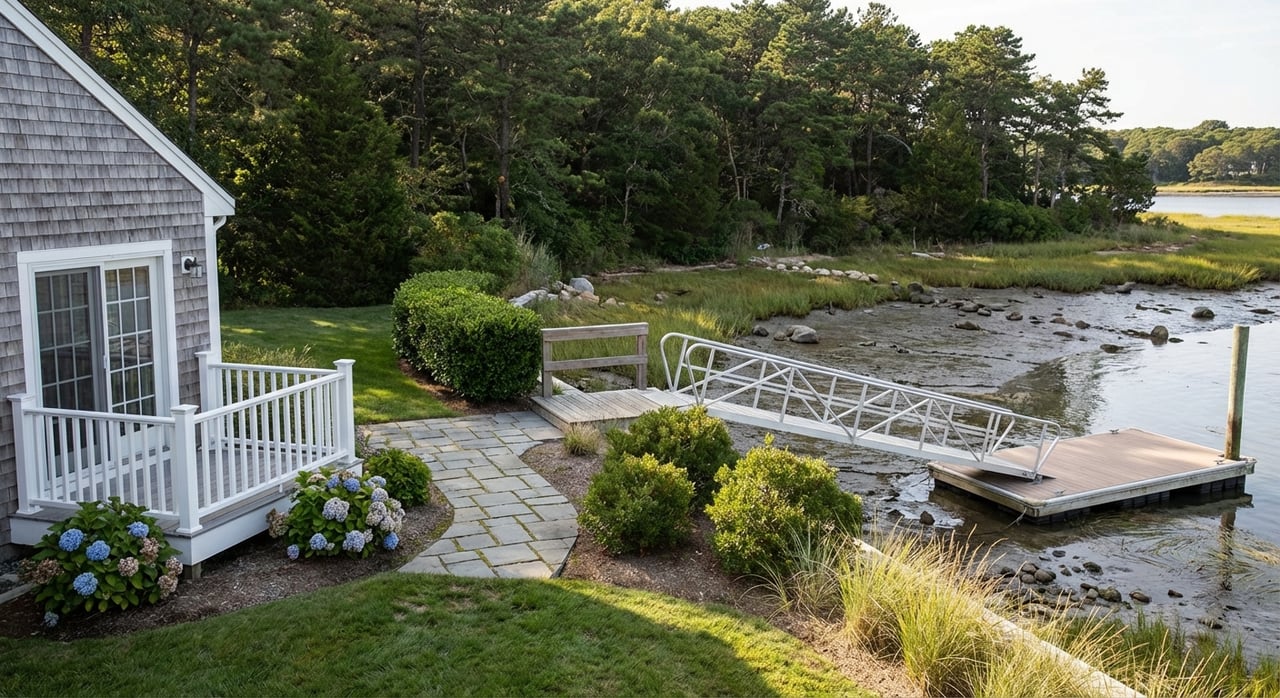
Ever picture yourself stepping from your back deck onto your boat for an easy run out to Buzzards Bay? If you are exploring West Falmouth, you are in the right place. The harbor here is beautiful and protected, but it is also managed with care, which means there are real rules, fees, and timelines to understand. In this guide, you will learn how moorings and docks work, what permits and fees to expect, and the key checks to make before you write an offer. Let’s dive in.
Why West Falmouth works for boaters
West Falmouth sits on Buzzards Bay and centers on West Falmouth Harbor, including Snug Harbor and Chapoquoit Point. The setting gives you quick access to open water with good protection inside the harbor. Mariners commonly use NOAA Chart 13230 for approaches.
Depths can be shallow in spots and the inlet is known to shoal. Local guidance notes areas where depths at low tide can fall to only a few feet outside the marked channel, so larger or deeper-draft boats should plan carefully and check recent local notices. You can review a harbor approach summary and cautions on the West Falmouth Harbor inlet page for context and planning purposes at marinas.com.
Know your docking options
Private moorings in West Falmouth Harbor
Many West Falmouth homeowners rely on a town-issued private mooring rather than a shore-tied dock. The Town of Falmouth sets tackle standards, approved anchor types, inspection schedules, and labeling rules. You can find these details in the town’s Mooring Regulation Highlights, which also explains transfer limits and the winter-stick schedule.
In some eelgrass recovery zones, the town and local partners encourage or require conservation moorings that reduce seafloor scouring. These typically use helix anchors with an elastic rode that lifts the chain off the bottom. Learn why conservation moorings are used and where they are being installed from the Buzzards Bay Coalition.
Town slips and facilities
Falmouth offers seasonal slips at town-managed docks, with resident and nonresident per-foot rates that vary by location and season. For budgeting, review the current Marine & Environmental Services fee schedule to understand per-foot slip rates, mooring fees by boat length, transient rates, and power charges. Availability changes, and some waitlists have been closed in recent years, so contact the Harbormaster early to confirm the latest status. The town posts harbor management updates and seasonal restrictions that are useful when planning.
Private docks and seasonal floats
Private docks do exist in West Falmouth, especially on protected inlets, but they are site specific and tightly regulated. Designs vary from pile-supported fixed piers to seasonal floats and small boat lifts. Expect to factor in permitting, potential habitat constraints, annual maintenance, and insurance. A recorded Chapter 91 license will govern use in state tidelands, so confirming the status of any existing structure is essential during due diligence.
Tides, depth, and clearance
In a tidal harbor, your usable water depends on mean low water and tide range. Use the nearest NOAA tidal benchmarks, such as the station near Chapoquoit Point, when you review listing details that reference MLW, MHW, or under-deck clearance. Ask sellers for elevation certificates and any recent soundings to confirm depth at your dock or mooring during typical low tides.
Outside the maintained channel, depths can drop quickly. If you have a moderate or deep draft, confirm controlling depths and whether the approach is dredged or likely to shoal. Tie your planning to the tidal datum for your specific parcel so you know exactly when your boat can come and go.
Ecology and permitting essentials
West Falmouth Harbor is ecologically sensitive and has active water-quality and habitat restoration. Eelgrass and shellfish beds are mapped and influence what you can build or install. Ask for the most recent eelgrass mapping for the parcel you are considering so you can anticipate design choices, such as pile-supported docks with light-penetrating elements or conservation moorings where required.
Permitting involves multiple layers. In coastal Massachusetts, most dock and in-water projects require local Conservation Commission review under the Wetlands Protection Act, state Chapter 91 Waterways authorization, and often federal review by the U.S. Army Corps for work in navigable waters. MassDEP and the state’s coastal program provide a clear overview of how these pieces fit together.
Some small, residential pile-supported docks that meet strict size and design limits may qualify for a simplified path under 310 CMR 9.10. Larger or more complex projects that involve dredging, fill, or habitat impacts usually require full Chapter 91 licensing and can take longer. Falmouth also posts time-of-year restrictions tied to species protection that affect when dredging or certain in-water work can occur. Finally, a Chapter 91 license should be recorded at the Registry of Deeds, so verify that any existing dock is properly licensed and recorded.
What dock-friendly homes cost in West Falmouth
Prices vary by frontage, depth and quality of access, dock rights, septic capacity, and views. As a general orientation:
- Entry or accessory water access. Occasionally available cottages or condos with limited or community access can trade under $1.0M.
- Mid-tier with direct access. Homes with a private mooring, community dock, or modest private dock commonly fall in the $1.0M to $2.0M range.
- High-end waterfront. Larger lots with private deep-water docks on protected water and strong channel access often start around $2.0M and extend to $3M or more.
Use recent neighborhood comps and confirm the status of any dock or mooring rights to position an offer. Small differences in depth at MLW, channel proximity, and licensing can create big swings in value.
Buyer checklist: before you write an offer
Work through this list to protect your purchase and timeline.
- Access type. Clarify if the listing offers a private dock, deeded right to a community dock, a town-issued private mooring, or no formal mooring. Confirm any claimed transferability with the Harbormaster and the town’s Mooring Regulation Highlights.
- Harbormaster status. Ask the listing agent to contact the Falmouth Harbormaster to verify the exact mooring location, waitlist status, and any conservation mooring or tackle requirements. Start early, since some waitlists may be closed or long.
- Permits on record. Request copies of any Chapter 91 license, Conservation Commission Orders of Conditions, and as-built dock plans. Confirm whether a Chapter 91 license is current and recorded at the Registry of Deeds.
- Depth and tides. Document measured depth at mean low water at the end of the dock or near the mooring. Use the nearest NOAA tidal benchmarks for consistency and ask for recent soundings if available.
- Habitat mapping. Obtain current eelgrass and shellfish maps for your exact parcel and approach. Where eelgrass is present, conservation moorings or modified dock designs are common.
- Fees and availability. Review the latest Marine & Environmental Services fee schedule for moorings and slips, and confirm current availability or waitlists with the Harbormaster.
- Time-of-year limits. Check Falmouth’s posted dredging and species-based windows. These can affect when you can perform dredging or in-water work.
- Septic and water quality. Get Title V results and ask if the property is in a nitrogen-sensitive area with potential septic upgrades or incentives. Local restoration programs have targeted shoreline systems.
- Flood risk and insurance. Review the FEMA flood zone, request an elevation certificate, and obtain an insurance estimate early. Waterfront premiums can be higher and will impact carrying costs.
A smooth path to the water
Buying a dock-friendly property in West Falmouth is part boating dream and part project management. Set yourself up for success by taking these steps:
- Call the Harbormaster early to confirm mooring or slip options, tackle requirements, and any waitlists.
- Assemble your documents: Chapter 91 license, Conservation Commission orders, as-built dock plans, recent soundings, and elevation certificates.
- Map your constraints: eelgrass, shellfish, flood zone, and any dredging time-of-year limits.
- Budget for annual town fees, insurance, and dock or seawall maintenance, along with potential septic updates.
- Work with a local, hands-on agent who knows the village-level nuances and can coordinate surveys, permits, and vendor access on your behalf.
If you are ready to weigh specific properties or want a second set of eyes on permits and access, connect with our local team at Ermine Lovell Real Estate. We combine village knowledge with white-glove coordination to help you land the right home and enjoy the water with confidence.
FAQs
What is the difference between a private mooring and a private dock in West Falmouth?
- A private mooring is a town-permitted anchor and buoy in a designated field, while a private dock is a shore-tied structure that requires additional local and state approvals and ongoing maintenance.
Are mooring permits transferable when buying a West Falmouth home?
- Mooring permits are issued annually to a named owner and vessel, and transfers are limited. You should confirm any claimed transfer or location with the Harbormaster before relying on it in a purchase.
How much do town slips and moorings cost in Falmouth?
- The town publishes a fee schedule each year. Expect per-foot slip rates that differ for residents and nonresidents and annual mooring fees that scale by boat length, plus potential power or transient charges.
Will eelgrass near my property affect a dock permit?
- Yes. Mapped eelgrass often leads to design changes, conservation moorings, or stricter review timelines. Always request the latest habitat maps for your parcel and plan accordingly.
What should I check about tides and depth before purchasing a waterfront home?
- Confirm depth at mean low water at your dock or mooring, review nearby tidal benchmarks, and verify any under-deck or bridge clearance that could limit your boat at different tides.
Do I need special permits to repair or replace an existing dock in Massachusetts?
- Most in-water work requires local Conservation Commission review and state Chapter 91 authorization, and some projects need federal review. The exact path depends on size, design, and environmental impacts.